
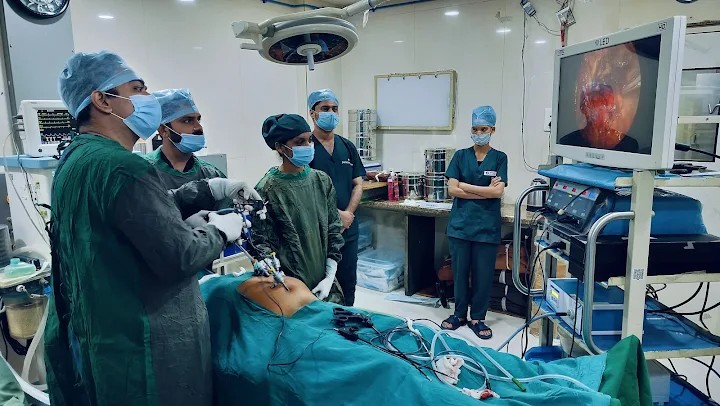
Advanced Laparoscopic Splenectomy in Morbi, Gujarat
Splenectomy is a surgical procedure to remove the spleen. It may be required for certain blood disorders, enlarged or damaged spleen, splenic cysts, tumours, traumatic splenic injuries and selected other conditions.
Dr. Vimal Detroja, MBBS, MS (General Surgery), DNB (General Surgery), FNB – Minimal Access Surgery, FALS – Colorectal & Bariatric Surgery, FIAGES, is an Advanced Laparoscopic, GI & Bariatric Surgeon at Laprocare Hospital – Advanced Laparoscopy & Bariatric Centre, Morbi, Gujarat.
With advanced training in Minimal Access Surgery from Sir Ganga Ram Hospital, New Delhi, Dr. Vimal Detroja provides evaluation and surgical treatment for selected patients requiring laparoscopic spleen surgery and splenectomy.
What Is Splenectomy?
A splenectomy is an operation to remove the spleen.
The spleen is located in the left upper abdomen, beneath the ribs. It is part of the immune and blood-filtering system and has important functions including:
- Filtering old or damaged red blood cells
- Participating in immune responses
- Supporting the body’s defense against certain bacteria
- Storing a proportion of circulating blood cells and platelets
Although the spleen has important functions, a person can live without a spleen when appropriate preventive measures and follow-up are provided.
Why Is Splenectomy Performed?
Splenectomy may be recommended for several different conditions.
1. Enlarged Spleen – Splenomegaly
An enlarged spleen can occur due to:
- Blood disorders
- Liver disease and portal hypertension
- Infections
- Haematological malignancies
- Storage disorders
- Other systemic diseases
Treatment depends on the underlying cause. Splenectomy is considered only in appropriately selected patients.
2. Hypersplenism
Hypersplenism occurs when an enlarged or overactive spleen excessively removes circulating blood cells.
It can result in:
- Low platelet count
- Anaemia
- Low white blood cell count
- Multiple cytopenias
In selected patients with significant hypersplenism, splenectomy may be considered.
3. Immune Thrombocytopenia – ITP
Immune thrombocytopenia (ITP) is a condition in which the immune system destroys platelets.
The spleen can play an important role in platelet destruction.
Splenectomy may be considered in selected patients with chronic or refractory ITP when other appropriate medical treatments have not provided adequate control.
The decision should be made in consultation with a haematologist and surgeon.
4. Hereditary Spherocytosis
In hereditary spherocytosis, abnormal red blood cells are preferentially removed by the spleen.
In appropriately selected patients with significant disease, splenectomy can reduce haemolysis and improve anaemia.
5. Splenic Trauma
A severely injured spleen following:
- Road traffic accident
- Fall
- Blunt abdominal trauma
- Sports injury
- Penetrating trauma
may cause potentially life-threatening internal bleeding.
Some splenic injuries can be treated without surgery using observation or interventional radiology.
However, emergency splenectomy may be required when there is uncontrolled bleeding or when non-operative management is inappropriate.
6. Splenic Cyst
Some splenic cysts may require surgery depending on:
- Size
- Symptoms
- Complications
- Risk of rupture
- Infection
- Cyst type
In selected cases, spleen-preserving surgery may be considered.
7. Splenic Tumours
Rare benign or malignant lesions of the spleen may require surgical evaluation.
The surgical approach depends on:
- Lesion type
- Size
- Location
- Symptoms
- Suspicion of malignancy
8. Splenic Abscess
A splenic abscess is a serious infection within the spleen.
Treatment may involve:
- Antibiotics
- Image-guided drainage
- Surgery
Splenectomy may be required in selected cases where drainage is unsuccessful or unsuitable.
9. Selected Blood Disorders
Splenectomy may be considered in selected patients with disorders such as:
- Hereditary spherocytosis
- Certain haemolytic anaemias
- Selected cases of ITP
- Hypersplenism
- Other rare haematological disorders
The indication should be established by the appropriate medical and surgical team.
Symptoms of Diseases That May Require Splenectomy
Symptoms depend on the underlying condition.
Possible symptoms include:
- Pain in the left upper abdomen
- Feeling of fullness after eating a small amount
- Abdominal discomfort
- Anaemia
- Easy bruising
- Recurrent infections
- Fatigue
- Low platelet count
- Enlarged spleen on examination or imaging
- Abnormal blood counts
- Fever
- Unexplained weight loss
A low platelet count alone does not automatically mean that the spleen should be removed.
Diagnosis Before Splenectomy
A careful evaluation is necessary before deciding on splenic surgery.
Investigations may include:
Complete Blood Count
CBC helps evaluate:
- Haemoglobin
- Platelet count
- White blood cells
- Red-cell indices
Peripheral Smear
A peripheral blood smear can provide important information in suspected haematological disorders.
Liver Function Tests
Liver disease and portal hypertension can cause splenomegaly and hypersplenism.
Ultrasound Abdomen
Ultrasound can assess:
- Spleen size
- Splenic lesions
- Portal vein
- Liver
- Associated abdominal abnormalities
Contrast-Enhanced CT Scan
CT can provide detailed information regarding:
- Spleen size
- Splenic lesions
- Splenic vessels
- Portal and splenic veins
- Lymph nodes
- Liver
- Pancreas
- Abdominal trauma
Additional Haematological Tests
Depending on the suspected condition, specialized tests may be required before surgery.
Laparoscopic Splenectomy
For appropriately selected elective patients, laparoscopic splenectomy is an established minimally invasive surgical approach.
Instead of a large abdominal incision, several small incisions are used to introduce:
- Camera
- Laparoscopic instruments
- Energy devices
- Specimen retrieval equipment
The spleen is mobilized and the splenic vessels are controlled before the spleen is removed.
Advantages of Laparoscopic Splenectomy
When technically appropriate, laparoscopic surgery can offer:
- Smaller incisions
- Reduced postoperative pain
- Earlier mobilization
- Faster recovery
- Shorter hospital recovery in many patients
- Better cosmetic results
However, the laparoscopic approach is not suitable for every patient.
Very large spleens, uncontrolled bleeding, extensive adhesions, severe portal hypertension or complex anatomy may require an open approach.
How Is Laparoscopic Splenectomy Performed?
The operation generally involves several stages.
Step 1 – Patient Positioning
The patient is positioned to provide optimal access to the left upper abdomen.
Step 2 – Laparoscopic Access
Small ports are inserted and the abdominal cavity is inspected.
Step 3 – Mobilization of the Spleen
The spleen is carefully mobilized by dividing the appropriate supporting attachments.
Step 4 – Control of Splenic Vessels
The splenic artery and vein are carefully controlled.
Step 5 – Removal of the Spleen
The spleen is separated from surrounding structures and removed.
Step 6 – Specimen Retrieval
The spleen may be placed into a retrieval bag and removed through an appropriately enlarged port site.
Step 7 – Final Inspection
The surgeon checks for:
- Bleeding
- Pancreatic injury
- Vascular injury
- Adequate haemostasis
Splenic Vessels and Pancreas: Why Expertise Matters
The spleen is anatomically close to the tail of the pancreas.
During splenectomy, inadvertent pancreatic injury can result in:
- Pancreatic leak
- Pancreatic fistula
- Intra-abdominal collection
- Prolonged recovery
The splenic vessels also lie close to the pancreas and stomach.
Therefore, meticulous dissection is important during splenectomy.
Open Splenectomy
Open splenectomy may be preferred in certain situations, including:
- Major splenic trauma
- Massive splenomegaly
- Uncontrolled bleeding
- Severe adhesions
- Complex vascular anatomy
- Some malignant conditions
- Situations where laparoscopic surgery is unsafe
The choice of approach should be based on patient safety and surgical requirements.
Splenectomy for Enlarged Spleen
A massively enlarged spleen can make laparoscopic surgery technically challenging.
Before surgery, the team may assess:
- Spleen dimensions
- Platelet count
- Haemoglobin
- Portal hypertension
- Splenic vein anatomy
- Collateral vessels
- Liver function
- Underlying haematological disease
In selected patients, laparoscopic splenectomy may still be possible.
Splenectomy for ITP
In ITP, the spleen can contribute to platelet destruction.
Splenectomy is generally not the first treatment for every patient with ITP.
Medical therapies are often used first.
Splenectomy may be considered for selected patients with persistent or refractory disease after appropriate medical treatment.
A haematologist should be involved in the treatment decision.
Splenectomy for Hereditary Spherocytosis
Hereditary spherocytosis causes abnormal red blood cells that are removed prematurely by the spleen.
Splenectomy can significantly reduce haemolysis in appropriately selected patients.
However, because removal of the spleen increases susceptibility to certain infections, the risks and benefits must be carefully considered.
Splenectomy for Trauma
Splenic trauma is different from elective splenic disease.
The primary objective in trauma is:
Control life-threatening haemorrhage.
Depending on the patient’s haemodynamic status and injury grade, management may involve:
- Observation
- Blood transfusion
- Intensive monitoring
- Angioembolization
- Surgery
Emergency splenectomy may be necessary in unstable patients with uncontrolled bleeding.
Can the Spleen Always Be Preserved?
No.
Spleen-preserving treatment is desirable when safely possible, particularly in selected traumatic injuries and some benign splenic lesions.
However, splenectomy becomes necessary when:
- Bleeding cannot be controlled
- The spleen is extensively damaged
- The disease requires complete removal
- Preservation is technically unsafe
- The underlying condition is best treated by splenectomy
Life Without a Spleen
A person can live without a spleen.
However, the spleen contributes to immune protection, particularly against certain encapsulated bacteria.
Therefore, patients undergoing planned splenectomy require appropriate preventive care.
Vaccination Before Splenectomy
Elective splenectomy patients should receive recommended vaccinations according to current immunization guidance.
Important vaccine categories include protection against:
- Pneumococcus
- Meningococcus
- Haemophilus influenzae type b
- Influenza
The exact vaccination schedule should be determined according to current guidelines, the patient’s age, vaccination history and clinical circumstances.
When possible, vaccines are generally planned before elective splenectomy to allow the immune system time to respond.
Infection Risk After Splenectomy
After splenectomy, there is a lifelong risk of severe infection known as overwhelming post-splenectomy infection (OPSI).
Although uncommon, it can progress rapidly.
Patients should therefore understand:
- Fever after splenectomy requires prompt medical attention.
- Vaccination is important.
- Medical advice should be sought early for significant infections.
- Individual patients may require additional preventive measures based on their risk profile.
Antibiotics After Splenectomy
Whether prophylactic antibiotics are required after splenectomy depends on:
- Age
- Underlying disease
- Immunological status
- Vaccination status
- Local guidelines
- Individual infection risk
The treating physician should determine the appropriate strategy.
Blood Counts After Splenectomy
The platelet count can rise significantly after splenectomy.
This is known as reactive thrombocytosis.
Patients may therefore require postoperative monitoring of:
- Platelet count
- Haemoglobin
- White blood cell count
- Coagulation parameters
In selected patients, the medical team may consider measures to reduce thrombotic risk.
Possible Complications of Splenectomy
As with any major surgery, complications can occur.
Potential complications include:
- Bleeding
- Infection
- Pancreatic injury
- Pancreatic fistula
- Intra-abdominal collection
- Portal or splenic vein thrombosis
- Deep-vein thrombosis
- Pulmonary embolism
- Wound infection
- Ileus
- Injury to adjacent organs
- Post-splenectomy thrombocytosis
Emergency splenectomy for trauma may have a different complication profile from elective laparoscopic splenectomy.
Recovery After Laparoscopic Splenectomy
Recovery depends on:
- Underlying disease
- Spleen size
- Surgical approach
- Patient’s general health
- Presence of complications
After surgery, patients are monitored for:
- Pain
- Bleeding
- Fever
- Platelet count
- Haemoglobin
- Bowel function
- Oral intake
- Thrombotic complications
Early mobilization and appropriate postoperative care help recovery.
When Should You Consult a Splenic Surgeon?
You may require specialist surgical evaluation if you have:
- Enlarged spleen
- Symptomatic splenomegaly
- Hypersplenism
- Persistently low platelets due to splenic sequestration
- ITP requiring consideration of splenectomy
- Hereditary spherocytosis
- Splenic cyst
- Splenic abscess
- Splenic tumour
- Splenic injury
- Recurrent splenic-related complications
Dr. Vimal Detroja – Advanced Laparoscopic & GI Surgeon in Morbi
Dr. Vimal Detroja is an advanced laparoscopic and gastrointestinal surgeon with specialized training in minimal access surgery.
Qualifications
MBBS
MS – General Surgery
DNB – General Surgery
FNB – Minimal Access Surgery
FALS – Colorectal & Bariatric Surgery
FIAGES
Advanced Training
FNB Training in Minimal Access Surgery – Sir Ganga Ram Hospital, New Delhi
His areas of surgical practice include:
- Advanced laparoscopic surgery
- Gastrointestinal surgery
- Abdominal surgery
- Colorectal surgery
- Hepatobiliary surgery
- Hernia surgery
- Bariatric surgery
- Metabolic surgery
- Emergency general surgery
Dr. Vimal Detroja – Professional Experience
Dr. Vimal Detroja has worked and trained in multiple surgical institutions, including:
Sir Ganga Ram Hospital, New Delhi
Advanced training and exposure to minimal access surgical procedures.
Civil Hospital, Morbi
Experience in general and emergency surgical care.
Aayush Hospital, Morbi
Surgical practice involving general and abdominal surgery.
Civil Hospital, Aizawl
Experience in general and emergency surgical management.
Jalaram Trust Hospital
Experience in general and abdominal surgical practice.
Laprocare Hospital – Advanced Laparoscopy & Bariatric Centre
Laprocare Hospital in Morbi provides surgical consultation and treatment for gastrointestinal, laparoscopic, bariatric and general surgical conditions.
Services include:
Advanced Laparoscopic Surgery
- Laparoscopic splenectomy
- Laparoscopic gallbladder surgery
- Laparoscopic appendix surgery
- Laparoscopic hernia repair
- Advanced abdominal laparoscopy
Gastrointestinal Surgery
- Gastric surgery
- Intestinal surgery
- Colorectal surgery
- Pancreatic and biliary surgical evaluation
- Gastrointestinal emergency surgery
Hernia Surgery
- Inguinal hernia
- Bilateral inguinal hernia
- Umbilical hernia
- Incisional hernia
- Complex abdominal wall hernia
Bariatric & Metabolic Surgery
- Sleeve gastrectomy
- Gastric bypass
- Weight-loss surgery
- Metabolic surgery
Frequently Asked Questions About Splenectomy
Can a person live without a spleen?
Yes. However, patients require appropriate vaccination and preventive care because the risk of certain serious infections increases after splenectomy.
Is laparoscopic splenectomy safe?
For appropriately selected patients, laparoscopic splenectomy is an established surgical procedure. Patient selection and surgical expertise are important.
Is splenectomy always done for an enlarged spleen?
No. Splenomegaly has many causes, and treatment should focus on the underlying disease. Splenectomy is performed only when there is an appropriate indication.
Does splenectomy cure ITP?
Splenectomy can provide durable remission in some appropriately selected patients with ITP, but it does not guarantee cure in every patient.
Can the spleen grow back after removal?
A completely removed spleen does not normally regenerate. However, small accessory spleens may occasionally be present and can become clinically relevant in selected conditions.
What happens to platelets after splenectomy?
The platelet count commonly increases temporarily after surgery and can become markedly elevated in some patients. Monitoring is therefore important.
Do I need vaccines before splenectomy?
Patients undergoing elective splenectomy generally require appropriate vaccination against organisms associated with severe post-splenectomy infections. Timing should be planned with the treating team.
Can splenectomy be performed during emergency trauma?
Yes. Emergency splenectomy may be necessary when severe splenic injury causes uncontrolled bleeding or when the patient is unstable.
Spleen Surgery & Splenectomy in Morbi
If you have been advised to undergo splenectomy, have an enlarged spleen, low platelets due to hypersplenism, ITP, hereditary spherocytosis, splenic cyst or splenic injury, specialist surgical evaluation can help determine whether surgery is appropriate.
Dr. Vimal Detroja
Advanced Laparoscopic, GI & Bariatric Surgeon
MBBS | MS (General Surgery) | DNB (General Surgery) | FNB – Minimal Access Surgery | FALS – Colorectal & Bariatric Surgery | FIAGES
Laprocare Hospital – Advanced Laparoscopy & Bariatric Centre
4th Floor, Subham Hospital Building
Savsar Plot 15, Vodafone Store Street
Sanala Road, Morbi – 363641, Gujarat, India
Phone / WhatsApp: 7984369579
Email: hr@laprocarehospital.com